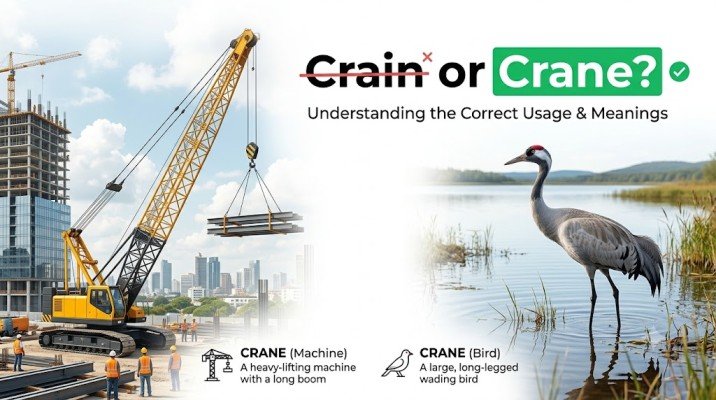
Many people search for “crain or crane” because they are unsure which spelling is correct. The confusion usually happens because both words sound very similar when spoken aloud. In everyday conversation, it can be difficult to hear the difference, especially when someone speaks quickly or with a regional accent.
Another reason people search this keyword is due to typing mistakes. When writing emails, school assignments, social media posts, or business documents, people may accidentally type “crain” instead of “crane.” Search engines receive thousands of spelling-related searches every day, and this is one example of a common spelling question.
The word crane has several meanings. It can refer to a large bird with long legs and a long neck. It can also mean a construction machine used to lift heavy objects. Because the word is widely used in many industries and contexts, correct spelling is important.
If you have ever wondered whether the correct spelling is crain or crane, this guide will explain everything clearly. You’ll learn the correct spelling, the history of the word, common mistakes, regional usage, examples, and answers to frequently asked questions.
Quick Answer
The correct spelling is crane.
Crane is a real English word that refers either to a tall bird with long legs and a long neck or to a machine used for lifting heavy objects on construction sites. The spelling crain is usually a typo, misspelling, or a surname rather than a standard English word.
Example:
✅ The construction workers used a crane to lift the steel beams.
❌ The construction workers used a crain to lift the steel beams.
The Origin of “Crane”
The word crane has a long history in the English language. It comes from the Old English word cran, which referred to the large bird we know today. Similar forms of the word existed in many Germanic languages, showing that the term has ancient roots.
Originally, the word was used only to describe the bird. Cranes are known for their long necks, long legs, and graceful appearance. They have been recognized by humans for thousands of years and appear in stories, art, and folklore across many cultures.
Over time, people noticed that some lifting devices had a shape similar to the bird’s neck. Because of this resemblance, the name crane began to be used for mechanical lifting machines. By the Middle Ages, the word was commonly associated with equipment designed to raise and move heavy objects.
Today, the word has two primary meanings:
- A large bird
- A lifting machine used in construction and industry
So where does crain come from?
In most situations, crain is simply a spelling mistake. Since the pronunciation of crane sounds similar to how some people imagine “crain” should be written, the error occurs naturally. Search engines often receive typo-based searches from users who are unsure of the correct spelling.
In some cases, Crain exists as a surname. However, as a standard English noun, crane is the accepted and correct spelling.
British English vs American English
One reason people check spelling differences is that many words vary between British and American English. Examples include:
- Colour vs Color
- Centre vs Center
- Organise vs Organize
However, the word crane is not one of those words.
Both British English and American English use the same spelling: crane. There is no regional spelling variation. Whether you are writing in the United Kingdom, the United States, Canada, Australia, or other English-speaking countries, the correct spelling remains identical.
This consistency makes the word easy to standardize in formal writing, education, journalism, and business communication.
British vs American Usage Table
| Type | British | American | Correct? | Example |
|---|---|---|---|---|
| Bird | Crane | Crane | Yes | The crane flew over the lake. |
| Machine | Crane | Crane | Yes | The crane lifted the cargo. |
| Misspelling | Crain | Crain | No | Incorrect standard spelling |
| Formal Writing | Crane | Crane | Yes | Use crane in reports. |
| Academic Usage | Crane | Crane | Yes | Preferred spelling everywhere |
Because there is no regional difference, writers should always choose crane regardless of audience location.
Why People Confuse “Crain” and “Crane”
Several factors contribute to confusion between crain and crane.
1. Similar Pronunciation
The biggest reason is pronunciation. The word crane is pronounced with a long “a” sound. Some people assume that sound should be represented by the letters “ai,” leading them to write “crain.”
2. Typing Errors
Fast typing often causes spelling mistakes. A writer may accidentally type “crain” without realizing it.
3. Autocorrect and Predictive Text
Although modern spell-checkers are useful, they are not perfect. Sometimes users ignore correction suggestions or fail to notice the highlighted mistake.
4. Search Engine Behavior
People often enter words exactly as they hear them. When unsure of spelling, they search for both possibilities. This behavior explains why searches for “crain or crane” occur frequently.
5. The Existence of the Surname “Crain”
The surname Crain is legitimate. People may see the family name online and mistakenly assume it is an alternative spelling of the common noun crane.
6. Limited Exposure
Some users rarely encounter the word in writing. They may know the spoken form but not the standard spelling, causing uncertainty when they need to write it.
For these reasons, confusion between the two spellings continues even though only one is correct in standard English usage.
Which Spelling Should You Use?
You should use crane in virtually all forms of writing.
This includes:
- School assignments
- Academic papers
- News articles
- Business reports
- Blog posts
- Emails
- Social media content
Professional dictionaries, style guides, and educational resources recognize crane as the standard spelling.
Using crain in formal writing may appear unprofessional because readers often recognize it as a spelling mistake. Search engines also understand that “crain” is usually intended to mean “crane.”
For SEO purposes, content creators should primarily use crane while addressing common misspellings when relevant. This helps satisfy user search intent without introducing spelling errors throughout the content.
Because English is used globally, following standard spelling conventions improves clarity and credibility. Readers from different countries will immediately recognize the word crane.
The simple rule is:
✅ Use crane for the bird.
✅ Use crane for the machine.
❌ Avoid crain unless it is someone’s surname or part of a proper name.
Common Mistakes with “Crane”
Many writers make similar errors when using the word crane.
Wrong vs Correct Examples
❌ The crain lifted the container.
✅ The crane lifted the container.
❌ We saw a beautiful crain near the river.
✅ We saw a beautiful crane near the river.
❌ The company rented a tower crain.
✅ The company rented a tower crane.
❌ The article discussed migratory crains.
✅ The article discussed migratory cranes.
❌ A large crain arrived at the building site.
✅ A large crane arrived at the building site.
Why These Mistakes Matter
Spelling errors can:
- Reduce professionalism
- Create confusion
- Hurt academic grades
- Affect business communication
- Lower content quality
Proofreading and spell-check tools help prevent these mistakes. Reading your work aloud can also help identify spelling errors before publication.
“Crane” in Everyday Examples
The word crane appears in many types of communication.
“The crane will arrive at the construction site tomorrow morning.”
News
“A tower crane was installed to support the city’s new development project.”
Social Media
“Just saw a beautiful crane flying over the wetlands today!”
Academic Writing
“The crane is known for its long migration routes and distinctive appearance.”
Business Communication
“Our team scheduled the crane delivery for next week’s project phase.”
Construction Industry
“The crane successfully lifted the steel framework into place.”
Wildlife Discussions
“Researchers tracked the movements of the crane during migration season.”
These examples show how the same word can describe either a bird or a machine depending on context.
Readers easily understand the intended meaning because the surrounding words provide clues.
Insight – Search Behavior
The keyword “crain or crane” is a classic example of typo-based search behavior.
Many internet users search according to pronunciation rather than spelling. When they hear the word crane, they may guess its spelling and type “crain” into a search engine.
Search engines have become very good at understanding these mistakes. Modern systems use natural language processing (NLP) to identify probable spelling errors and connect users with relevant information.
When someone searches for:
- Crain meaning
- Crain or crane
- Is crain correct
- Crane spelling
Google often recognizes that the user may be looking for the word crane.
Search intent behind these queries usually falls into one of four categories:
- Spelling verification
- Word meaning
- Grammar and writing help
- Educational research
From an perspective, addressing both the correct spelling and the common misspelling helps content satisfy user needs more effectively.
Writers should acknowledge the typo while clearly emphasizing the correct spelling. This approach improves relevance and user experience without encouraging incorrect usage.
As search engines continue improving language understanding, they increasingly recognize relationships between misspelled and correctly spelled words.
Comparison Table – Crain vs Crane
| Term | Meaning | Correct/Incorrect | Context |
|---|---|---|---|
| Crane | A bird with long legs and neck | Correct | Wildlife |
| Crane | A lifting machine | Correct | Construction |
| Crane | Standard English spelling | Correct | All formal writing |
| Crain | Usually a typo of crane | Incorrect | Common spelling mistake |
| Crain | Family surname | Correct as a name | Proper nouns |
| Crane | Academic usage | Correct | Schools and universities |
| Crane | Business communication | Correct | Professional writing |
| Crain | General noun usage | Incorrect | Avoid in writing |
The comparison clearly shows that crane is the accepted spelling in standard English.
FAQs
What is the correct spelling: crain or crane?
The correct spelling is crane. It is the standard English word used to describe both the large bird and the machine that lifts heavy objects. The spelling “crain” is generally considered a misspelling or typo. If you are writing an email, article, report, or school assignment, you should always use crane unless Crain is part of a person’s name.
Is crain a real word?
In standard English vocabulary, crain is not commonly recognized as a regular noun. However, Crain can exist as a surname or part of a business name. When referring to the bird or construction machine, the correct spelling remains crane. Most dictionaries and style guides do not list crain as an accepted alternative spelling.
Why does confusion between crain and crane happen?
The confusion occurs mainly because of pronunciation. The long “a” sound in crane may lead some people to believe the word should be spelled with “ai.” Typing mistakes, search habits, and unfamiliarity with the word also contribute to the confusion. Because both spellings look plausible, many users search online to verify the correct form.
Which spelling should I use in professional writing?
You should always use crane in professional writing. This applies to business documents, academic papers, marketing materials, websites, and emails. Using the standard spelling improves clarity and credibility. Readers expect correct spelling, and using crain may make the writing appear less polished or accurate.
Is crain simply a typo?
In most cases, yes. When people write crain, they usually intend to write crane. It is one of many spelling errors caused by pronunciation-based guessing. Search engines frequently encounter this typo and often guide users toward information about crane. Unless used as a surname, crain is generally considered incorrect.
What does the word crane mean?
Crane has two main meanings. First, it refers to a large bird known for its long neck, long legs, and graceful movements. Second, it refers to a machine used for lifting and moving heavy materials, especially in construction and shipping industries. Context usually makes the intended meaning obvious to readers.
Can crain ever be used correctly?
Yes, but only in limited situations. Crain may be correct when it is part of a person’s last name, company name, or another proper noun. Outside those specific cases, crane is the correct spelling. If you mean the bird or the construction machine, you should use crane.
Is there a UK vs US spelling difference?
No. Unlike some English words that have different British and American spellings, crane remains the same in both versions of English. People in the United Kingdom, United States, Canada, Australia, and other English-speaking countries all use the spelling crane. There is no accepted regional variation involving crain.
Conclusion
The answer to the question “crain or crane” is simple: crane is the correct spelling.
you are talking about the elegant bird found in wetlands or the powerful machine used on construction sites, standard English uses the spelling crane. The form crain usually appears because of pronunciation-based guessing, typing errors, or confusion caused by surnames that use that spelling.
Fortunately, the distinction is easy to remember. Every major English dictionary, educational resource, and style guide recognizes crane as the proper spelling. There is also no difference between British and American English, making the choice even simpler.